


How to Ship Agentic AI in Facilities Management — 6 Lessons from McKinsey
McKinsey analyzed more than 50 real-world AI agent deployments and identified six key lessons: success doesn’t come from flashy demos, but from redesigned workflows, governed agents, and full traceability. This article explains how to apply McKinsey’s blueprint to Facilities Management—and how Axiomova turns it into measurable ROI.
FACILITIES MANAGEMENT
Amal NOZIERES
9/28/20255 min read


The Hard Truth About Agentic AI
After a year of agentic AI deployments, McKinsey's latest research reveals a sobering reality: many companies are rehiring people where agents have failed. Despite the promise of "unmatched productivity," organizations are struggling to see value from their AI investments.
But some are succeeding spectacularly. What's the difference?
McKinsey studied over 50 agentic AI builds to find out. Their conclusion: most companies are doing it wrong.
For Facilities Management (FM), these lessons aren't just insights—they're survival tactics for an industry under pressure to do more with less.
The McKinsey Blueprint: 6 Lessons That Actually Work
1. Redesign the Workflow, Not the Agent
McKinsey's insight:
"Achieving business value with agentic AI requires changing workflows. Organizations focus too much on the agent or the agentic tool, leading to great-looking agents that don't actually improve the overall workflow."
The FM Reality Check:
Your building management system can detect a water leak in real-time. But if that alert just sits in a dashboard waiting for someone to notice, triage, assign, and track—you haven't solved the problem. You've just digitized the chaos.
How Axiomova Redesigns FM Workflows:
Before: Leak detected → Dashboard alert → Manual triage → Email forwarding → Lost in inbox
After: Leak detected → Auto-classification → Work order creation → Vendor notification → Progress tracking → Completion verification
We don't just drop an agent into your existing mess. We reimagine the entire workflow around outcomes: faster response, complete visibility, automatic compliance documentation.
2. Use Agents Only Where They Matter
McKinsey's framework:
"Business problems can often be addressed with simpler automation approaches, such as rules-based automation, predictive analytics, or LLM prompting, which can be more reliable than agents out of the box."
The FM Decision Matrix:
Low variance, high standardization (invoice matching, PO validation) → Rules-based automation
High variance, low standardization (emergency escalation, vendor disputes) → AI agents
Everything in between → The right mix for each task
Real Example:
A three-way invoice match doesn't need an agent to "reason" through probabilities. A rule that checks PO number = Invoice number = Delivery receipt is faster, cheaper, and 100% reliable. Save the agents for complex judgment calls.
3. Onboard Agents Like Employees
McKinsey's warning:
"It's common to hear users complain about 'AI slop' or low-quality outputs. Users quickly lose trust in the agents, and adoption levels are poor."
The FM Risk:
In FM, that could mean an agent mis-assigning an HVAC emergency as routine cleaning. One mistake like that and trust collapses.
The McKinsey Solution: Treat agents like new hires, not software deployments.(McKinsey report)
Axiomova's Agent Onboarding Process:
Clear job description: What exactly should this agent do?
Training on real workflows: Not generic examples—your actual FM scenarios
Performance evaluations: Test outputs against historical cases
Continuous feedback loops: Regular refinement based on user input
Compliance guardrails: Built-in checks for regulatory requirements
Result: Agents that users trust instead of circumvent.
4. Make Every Step Traceable
McKinsey's lesson:
"Many companies track only outcomes. So when there's a mistake—and there will always be mistakes as companies scale agents—it's hard to figure out precisely what went wrong."
The FM Compliance Imperative:
When an invoice gets flagged for compliance issues, your CFO doesn't want to hear "the AI rejected it." They need to know exactly which regulation was triggered, which document was missing, and which step failed.
Axiomova's Audit Trail:
Every workflow creates a complete paper trail:
Input received (email, alert, document)
Classification decision and confidence score
Data sources retrieved and reasoning applied
Action taken and approval chain
Final outcome and compliance verification
Auditors can replay any decision sequence. Managers can spot patterns. Teams can improve processes.
5. Build Once, Reuse Everywhere
McKinsey's efficiency principle:
"Companies often create a unique agent for each identified task. This can lead to significant redundancy and waste because the same agent can often accomplish different tasks."
The FM Portfolio Challenge:
You manage 50 buildings with HVAC, electrical, plumbing, security, and cleaning needs. Building 250 separate agents is organizational suicide.
Axiomova's Modular Architecture:
One classifier handles all inbound requests (HVAC, electrical, cleaning, security)
One retrieval system accesses all documentation (manuals, contracts, compliance)
One workflow engine routes all task types (urgent, routine, compliance)
One audit system tracks all decisions across all properties
Result: 80% faster deployment across your portfolio. Consistent behavior everywhere.
6. Keep Humans in the Loop
McKinsey's reality check:
"Agents will be able to accomplish a lot, but humans will remain an essential part of the workforce equation even as the type of work that both agents and humans do changes over time."
The FM Evolution:
Your facility managers won't be replaced. But they'll stop being human email routers and become strategic decision-makers.
Before and After:
Before: 4 hours/day triaging and forwarding emails manually
After: 30 minutes/day reviewing agent decisions and handling exceptions
Net effect: More time for strategic planning, vendor relationships, and proactive maintenance
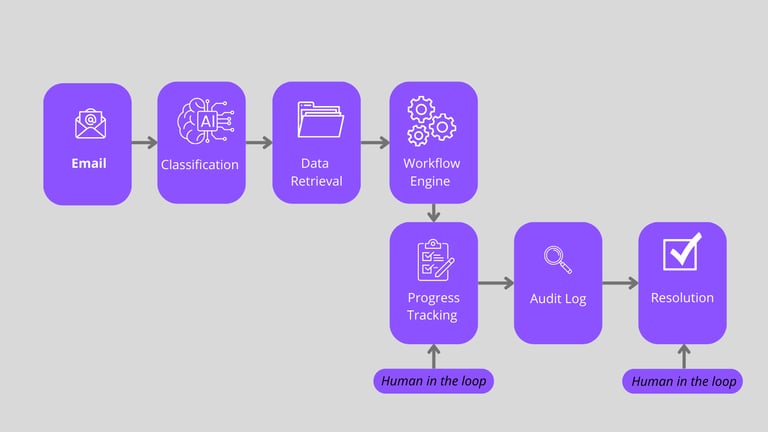
The Architecture in Action: McKinsey's "Agentic AI Mesh" for FM
Here's what McKinsey's framework looks like when applied to facilities management:
Scenario: "Conference Room B AC not working, meeting in 2 hours"
Email Classification: Agent identifies as urgent HVAC request
Data Retrieval: System pulls Room B specs, HVAC vendor contracts, SLA requirements
Workflow Orchestration: Creates priority work order, alerts HVAC contractor, notifies facilities manager
Progress Tracking: Vendor confirms ETA, updates work order status
Compliance Logging: Documents response time for SLA reporting
Resolution Verification: Confirms repair completion, closes loop with requestor
Human Involvement: Facilities manager approves contractor selection (high-value decision), reviews completion (quality check), but doesn't manually route emails or chase updates.
Case Study: From Theory to Results
Client Challenge:
200+ daily support requests buried in email chaos. Facilities managers spending entire mornings just figuring out who should handle what.
Axiomova Solution:
Redesigned email → resolution workflow end-to-end
Deployed targeted mix of rules, retrieval, and agents
Built full audit trail for compliance
Trained agents on 1,000+ historical cases
Results in 3 Weeks:
Manual triage time reduced by 87% (4 hours/day → 15 minutes/day)
Response time improved by 88% (6 hours → 45 minutes)
Audit readiness: From "scrambling" to "always ready"
25% operational cost reduction, €45,000 saved in first quarter
This is McKinsey's blueprint in production, not just theory.
Ready to Join the Winners?
McKinsey's research is clear: the companies succeeding with agentic AI aren't just deploying agents—they're fundamentally reimagining how work gets done.
Smart Start POC: McKinsey's Framework, Your FM Operations
In 14 days, we'll demonstrate:
✅ 3 redesigned workflows (not just agent deployments)
✅ Full step-by-step audit trails
✅ Mix of rules, retrieval, and agents optimized for each task
✅ Live demo on your actual FM data
Timeline: 2 weeks to working system
No lock-in: All workflows, connectors, and documentation are yours to keep even if you don't continue
👉 Book your 15-minute strategy call →
We’re opening just 3 Smart Start POC slots this month to keep delivery hands-on and fast.
The difference between AI pilots that fail and AI systems that transform operations? Following McKinsey's blueprint instead of chasing the latest demo. Let's build yours.
AI-powered helpdesk for facilities management. From inbox to work order in seconds.


© 2026 Axiomova. All rights reserved.
Product
Company
Resources
Tomorrow's FM article